
Well, that was a year. 2025 will be remembered as the year LEGO finally crossed the psychological $1,000 barrier, introduced their first-ever Star Trek set, and bid farewell to one of the greatest castle sets ever made. Pour yourself a beverage, settle into your building chair, and let's look back at twelve months that gave us plenty to talk about.
The Big One: 75419 Death Star
Let's address the elephant in the room—or rather, the 9,023-piece battle station that's too large for most rooms.
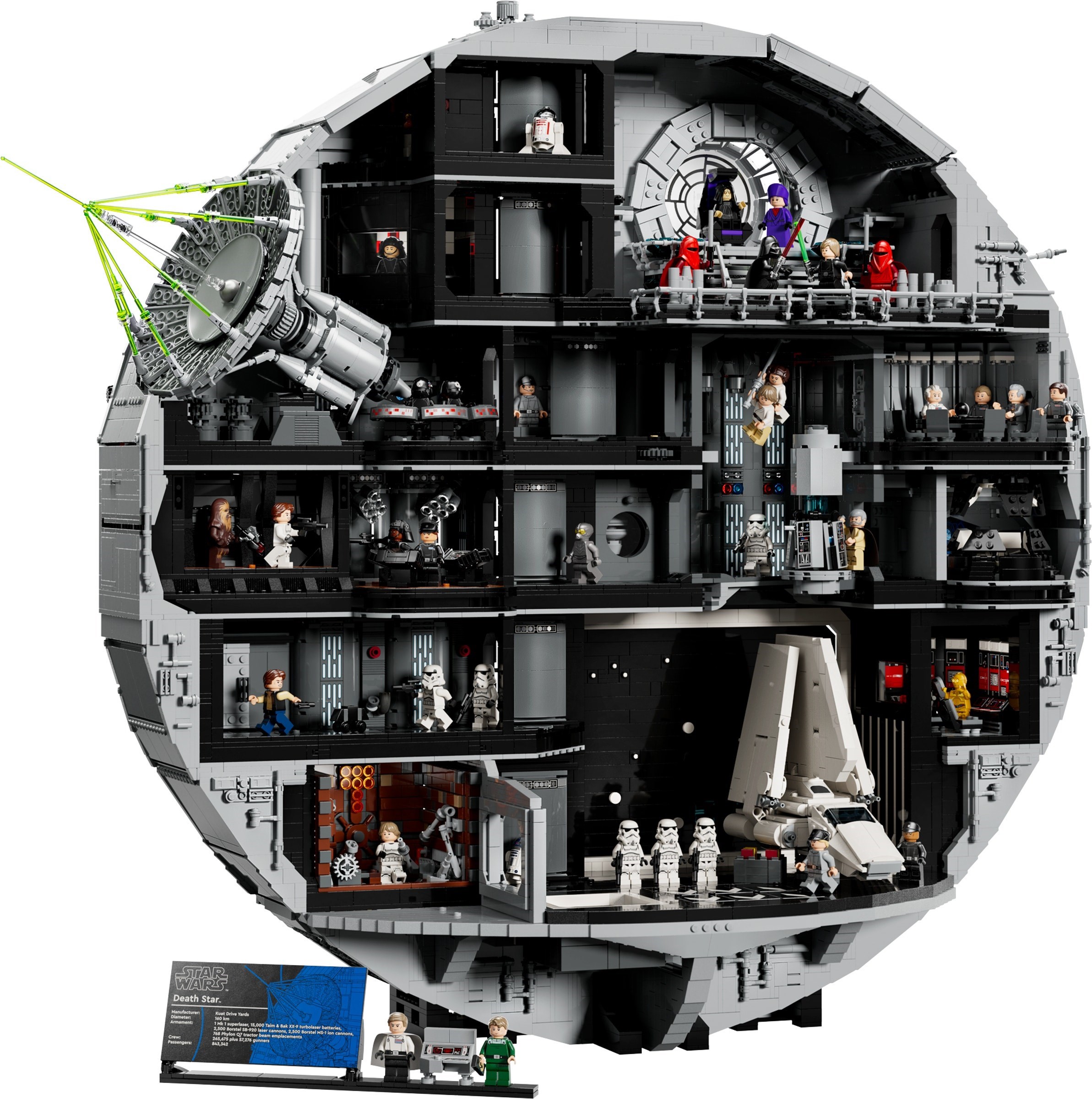
The 75419 UCS Death Star arrived in October with a price tag that made even seasoned collectors wince: $999.99 USD. Yes, LEGO's first four-digit set is here, and opinions remain... divided.
On paper, the specs are impressive. Over nine thousand pieces. Thirty-eight minifigures (a new record). Dimensions of 70cm tall by 79cm wide. Every iconic location from the original trilogy crammed into one massive cross-section—the trash compactor, the detention block, the Emperor's throne room, the tractor beam controls. It's essentially a Death Star dollhouse, and if you've got the space and the funds, it makes for quite the display piece.
But here's where things get spicy. For a thousand dollars, many fans expected LEGO to pull out all the stops. Instead, we got minifigures with compromises that wouldn't raise an eyebrow in a $50 set but feel harder to swallow at this price point. C-3PO is missing the dual-molded leg detail that's available in the $125 buildable figure—and even in a $5 keychain. Imperial officers lack dual-molded legs. Several characters appear in forms that are, frankly, available in better quality elsewhere.
LEGO's explanation—that minifigure design decisions are made consistently across price points—didn't land well. As one Redditor put it: "For $1k US, it should have all printed pieces, dual-moulded legs, and maybe even a few more minifigures." The expectation was that LEGO's most expensive set ever would showcase what the company could do when budget wasn't a concern. Instead, it showcased what LEGO always does, budget-conscious compromises included.
The cross-section design itself generated its own controversy. Previous Death Star sets attempted the full sphere. This one gives you a slice—half a model for double the price, some would say. Others argue the interior detail wouldn't have been possible with a spherical design, and they're probably right. Whether that tradeoff was worth it depends entirely on what you wanted from this set.
Will it sell? Absolutely. Has it sparked more debate about LEGO pricing than any set in recent memory? Also absolutely.
End of an Era: Lion Knights' Castle Retires
Speaking of sets worth talking about, 2025 marked the end of the road for 10305 Lion Knights' Castle, and its departure stings.
Released in 2022 as LEGO's 90th anniversary flagship set, this 4,514-piece fortress has been the gold standard for modern castle building. Twenty-two minifigures, 21 of them exclusive. A design that could open up for play or close for display. Callbacks to classic Castle sets that made longtime fans misty-eyed. At $399.99, it was expensive, sure, but it felt like you were getting your money's worth.
The retirement itself became a minor fiasco. During LEGO Insiders Weekend in November, the set sold out within minutes of the 20% discount going live. Then came the cancelled orders—many fans who thought they'd secured a copy found their orders voided, leading to understandable frustration. The aftermarket has already responded accordingly, with sealed sets commanding premiums that will only grow.
For castle fans, this leaves a real gap in the portfolio. There's been talk of a new Creator 3-in-1 castle coming in 2026, but nothing on the scale of Lion Knights' has been announced. Some speculate that the retirement opens the door for a LEGO Lord of the Rings Helm's Deep or even Minas Tirith—the logic being that LEGO wouldn't want two massive grey castles competing for shelf space. Time will tell.
If you missed out, I'm sorry. If you grabbed one, hold onto it.
The Pleasant Surprises
Not everything in 2025 was controversy and wallet pain. A few releases genuinely delighted:
Star Trek Finally Arrives
After years of the license being held elsewhere, 10356 Star Trek: U.S.S. Enterprise NCC-1701-D warped into existence in November. It's real. It happened. LEGO Star Trek is no longer a pipe dream.
The Enterprise-D looks fantastic—the saucer section separates, the nacelles light up (with a separate purchase), and the nine included minifigures cover most of the TNG bridge crew. It's not cheap at $399.99, but for Trekkies who've waited decades for this, it's essentially a miracle. The big question now is what comes next. Deep Space Nine? Voyager? The original Enterprise? LEGO has a whole universe to explore.
Tudor Corner Sets the Standard
January's 10350 Tudor Corner modular building arrived with less fanfare than some sets but quietly established itself as one of the best modulars in years. The Tudor-style facade is genuinely beautiful, the interior details are dense and delightful, and it proved that the Modular Buildings Collection still has plenty of creative gas in the tank. If you're into the line, this one's essential.
Happy Plants Brings Joy
Sometimes the best sets are the small ones. 10349 Happy Plants from the Botanicals line costs around $30 and delivers a ridiculous amount of charm. Three little succulents in their pots, simple builds, and the kind of "gift for a friend who doesn't know they like LEGO yet" energy that the theme does so well.
The Game Boy Delivers Nostalgia
Nintendo fans got 72046 Game Boy, a 1:1 scale replica complete with swappable cartridges for The Legend of Zelda: Link's Awakening and Super Mario Land. The on/off switch clicks. The screen has lenticular displays. It's everything you'd want from a LEGO tribute to the handheld that defined a generation.
The Pricing Conversation
It wouldn't be a 2025 retrospective without acknowledging the broader discourse around LEGO pricing this year. The Death Star was the headline, but it wasn't alone.
The 10366 Tropical Aquarium drew criticism for its $479.99 price tag—a lot of money for what some felt was mostly empty space and plain black framing. 75409 Jango Fett's Starship at $299.99 felt steep to many, particularly given the perceived lack of detail on the Young Boba minifigure. The pattern repeated across themes.
LEGO's response has been consistent: sets are priced according to piece count, licensing, and production costs. Fans' response has also been consistent: higher prices demand higher quality, and "that's how we've always done it" doesn't cut it when you're asking for four figures.
Where this conversation goes in 2026 remains to be seen. LEGO isn't likely to lower prices, but the intensity of fan feedback might influence how they approach flagship sets going forward. Or it might not. We'll see.
Looking Ahead
As we turn the page to 2026, a few things seem certain: LEGO will continue pushing into licensed territory (more Star Trek, presumably), the Modular Buildings Collection will keep delivering, and at least one set will generate the kind of spirited debate that keeps LEGO communities thriving.
Here's hoping your favorite sets stay in stock, your orders don't get cancelled, and your shelves have room for whatever catches your eye. Happy building.
Sources
- Brick Fanatics - 10 Most Expensive LEGO Sets of 2025
- Jay's Brick Blog - UCS Death Star Officially Revealed
- Brick Fanatics - LEGO's Reasons for Death Star's Compromises
- Brick Fanatics - Lion Knights' Castle Retiring
- Brick Fanatics - Lion Knights' Castle Sold Out
- Jay's Brick Blog - Tudor Corner Review
- Brick Fanatics - Top 10 LEGO Sets of 2025
What were your LEGO highlights (or lowlights) of 2025? Hit us up—we'd love to hear what made it onto your shelves this year.